Makes No Difference
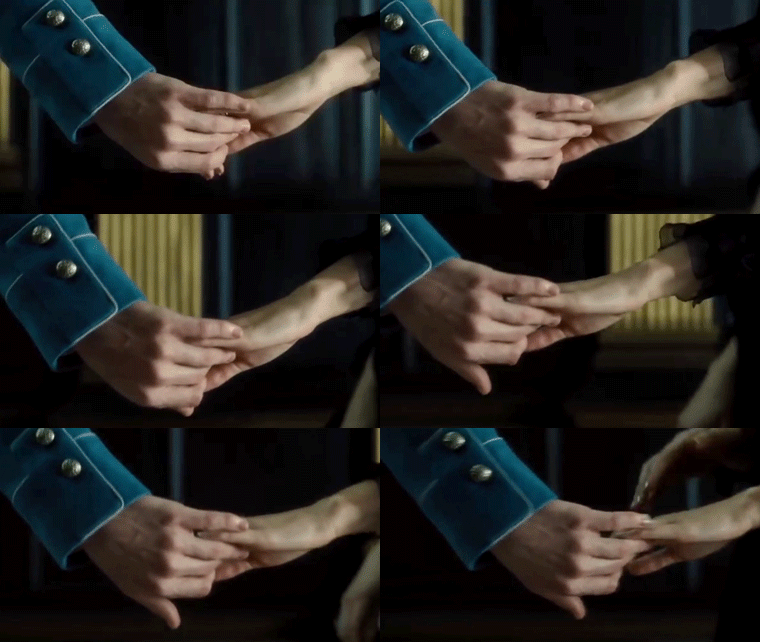
You know that feeling when you sense a movie you’re about to watch is going to be important to you in some way—because of something you’ll discover in it—regardless of the fact that you already know the story? There’s a hidden gem in it, and you need to see it, hear it, read it, at the exact moment in your life when that specific message needs to reach you.
Not sooner.
Not later.
Just then.
I was supposed to watch this movie six or seven times, in four different cities around the globe. And every time I was about to see it, something happened that made it impossible, or pulled me away from it. So I figured I wasn’t ready.
There is a specific emotional state you need to be in to see certain things at a specific time, to realize something. Isn’t life grand in how it does that? And isn’t it terrifying how sometimes—more often than we’d like—life feels pretty damn predetermined? As if there’s an entire scenario brewing for you somewhere in the future while you’re busy dwelling on mundane things in the present, things that won’t even matter in the grand scheme of things.
Christ, how unimportant we all are.
And how damn important, at the same time.
Everything is already there: the hurt, happiness, pain, love, lust, disappointments, challenges, beauty in overcoming.
We only have to live it.
Aside from the fact that this movie gave me more orgasms than real living people, visually, from the theater stage dissolving into movement, or movement metamorphosing back into the theater stage, from choreographed office scenes to subliminal costumes you want to steal and wear unapologetically in the present, the pain and frustration Keira Knightley so realistically and painfully transferred onto me—there is the story.
We all know the story.
It’s been told and adapted for the screen dozens of times. And that is exactly my fascination with it. How universal it is. How something written in the 1870s can make every single emotion feel relatable to every human being, across any period or place on this planet.
Fidelity.
Jealousy.
Passion.
Lust.
Before seeing it, I wondered what the director Joe Wright could possibly bring to an adaptation that’s been done a gazillion times already. But Joe delivers. He delivers through stages, choreography, and an unexpected yet phenomenal cast.
This Karenina cannot be explained with words.
It has to be experienced.
The story.
The one we read, watched, and lived.
(Minus the train part. Bless.)
And we all did.
We’ve all experienced lust and passion beyond reason, when you know you shouldn’t, but you absolutely have to. It demands you. It militates you. Lust is the most powerful force, impulse, and drive.
It’s not love.
It’s not sex.
Love is calm, sweet, rewarding, and fulfilling in a quiet, unaggressive way.
Sexual act is physical. It doesn’t demand anything we don’t want to give. And even when it does, it could be over in a blink—we get up, get dressed, and we don’t have to be altered.
Not if we don’t want to be.
We have a choice.
But lust?
Lust can’t be controlled. Passion can’t be controlled. And it can’t be ignored. It messes with you because it’s not simple or one-sided. It’s layered. It has love and sex tangled together. It’s physical and mental and emotional, all at once, and all-consuming.
Lust is absorbing.
Lust is difficult to deal with, even when there’s nothing else to contend with. But when fidelity enters the equation? When society, morality, and the self are thrown into the mix?
That’s where it explodes.
The parallels of human conduct are what made Anna Karenina “the greatest novel ever written.” Because it contrasts something overwhelming with restraint. Because it juxtaposes an arid marriage with the inevitability of passion. Because Tolstoy searched the self—and the place of the self within existence—so monumentally that it still sends shivers.
And what makes it tragic isn’t the train. It’s the self. How we feed the self with what it needs, knowing full well that the very same thing may eventually destroy it.
The inevitability.
And God, the dialogue is monumental.
Anna: “This is wrong.”
Vronsky: “Makes no difference.”
Anna: “You have no right.”
Vronsky: “Makes no difference.”
Anna: “Because I’m so happy. Not to think. Only to live, only to feel.”
Anna: “If you have any thought for me, you will give me back my peace!”
Vronsky: “There can be no peace for us—only misery and the greatest happiness.”
Have you ever been with someone you weren’t supposed to be with, but simply had to be?
It really is only misery and the greatest happiness.
My favorite scene in the movie is when Anna returns home after being with Count Vronsky, trying to sneak into the house while her husband is still awake, waiting. She’s completely absorbed in her emotions, floating through the air like we all do when drugged with love and lust, but her husband stops her. He wants to talk. He asks where she’s been.
Instead of lying or pretending, she’s annoyed that he’s even asking. She wants to bask in the bliss of an all-consuming love, one that can’t be bothered with something as substantial as one’s husband.
She turns toward him, tells him exactly where she’s been, says she’s tired, and needs to go to her room. Completely oblivious to right and wrong, absorbed in her passion and her self, powerless to both.
Lust is the strongest force in human experience, and yet the most powerless.
Probably one of the best quotes on lust is captured by its most controversial observer, Marquis de Sade: “Lust’s passion will be served; it demands, it militates, it tyrannizes.”
And it does.
Every single time.